

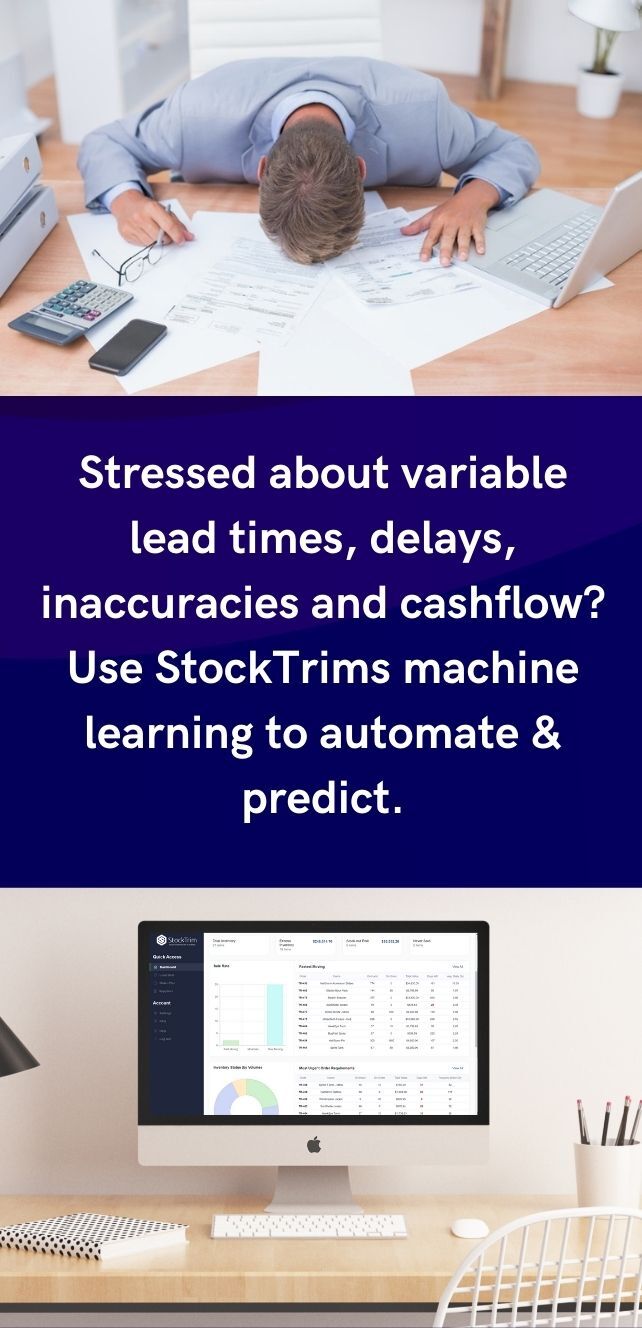
Every ecommerce founder I've spoken to has this problem sooner or later. Orders go up and suddenly the spreadsheet that was doing perfectly fine at $50,000 per month can't cope at $500,000 per month. Not because the founder became worse at their job, but because manual forecasting scales linearly with work and ecommerce growth scales exponentially.
Quick answer: ecommerce inventory forecasting software forecasts what stock a business will need based on their actual sales velocity through multiple channels to reorder before the stockout without tying capital in the incorrect products. In other words, it connects directly to the ecommerce shop and inventory management software, not forcing a business owner to export everything and fill in a separate system.
Here's something many software vendors won't admit: growth is what kills inventory forecasting, not seasonality. Everyone is afraid of Black Friday. What happens in silence, month after month, is when a brand grows and increases their order volume and doesn't adjust their processes to accommodate.
For instance, one of our clients – Australian beauty accessories brand – is a great example of how it works in practice. Its founder started selling a handmade beauty tool as a side project during university years and turned it into multi-million dollar brand within two years that was distributed across multiple retailers in Australia and internationally. With growth, stakes of getting the inventory planning wrong become higher. It's not just about losing a sale, it's about losing retailer partnership due to stockouts as the retail partner has alternatives.
What I find impressive about the story is how quickly the transition occurred. Two years is not a long time to grow from side project to national retail presence. The companies that manage to do it successfully are the ones that have forecasting infrastructure set up in advance, not after the stockout already cost them a retail partner.

Why Ecommerce Forecasting Is Its Own Challenge
The processes of retail forecasting and ecommerce forecasting seem the same on paper. However, ecommerce sales can grow overnight due to a single blog post, influencer shout-out, or changes in the marketplace algorithm. And that increase becomes part of the sales history, not just a one-time event. The software designed for ecommerce inventory forecasting knows how to recognize a change in the demand pattern versus a random spike, unlike basic moving average approach. Shopify itself made a similar point in their research: tools that work are the ones designed for ecommerce demand behavior, not the ones adjusted from retail experience.
Another issue is the channel complexity. Brand that sells their products via their own Shopify store, Amazon, and several retail partners needs to forecast sales across those channels and aggregate them into one coherent order. Doing it incorrectly means either having excess stock on the website and empty shelves with a retail partner or vice versa.
What to Actually Look For
Don't even consider anything that requires manually uploading weekly reports. The idea of e-commerce inventory forecasting software is in connecting to Shopify, WooCommerce, Amazon, or whatever platform is used, importing data from there, and adjusting recommendations each time the new orders come in. If a tool requires exporting one report and then uploading another, it's basically a fancy version of a spreadsheet, not a forecasting solution.
Here's the other opinion of mine, and I don't think many people would agree with me: most brands don't need artificial intelligence, they need consistency. The model that consistently applies the same logical approach to each product each week is going to outperform complicated black box that sometimes nails the forecasting perfectly but fails to justify the result. What mattered in the case of our client – beauty brand – was not the model complexity, but the ability to see the logic behind the recommendations.

The Problem Nobody Talks About: Starting a New Product Without Historical Data
If you've ever ordered the initial quantity of a brand new product with no historical sales data to use, you know what I mean. At that moment, forecasting is impossible and you're just guessing whether the order is going to be correct or not. If it's wrong, the result can be either excess stock that will never be sold or scrambling to reorder something that unexpectedly went viral. The software that does ecommerce inventory forecasting properly should have a mechanism to forecast the sales for a new SKU based on an existing product's sales pattern. If a software vendor can't explain what they're doing for a new product specifically, ask for that information before buying as this is where most tools fail silently.
Handling Growth Without Reacting to Each Spike
The first reaction to an increased sales number is to reorder immediately. However, in some cases it can be a one-time anomaly and a company is going to be left with six months worth of inventory. The good ecommerce forecasting software knows how to distinguish the trend from the noise and apply proper weights to recent data without overreacting to each spike, which is exactly the type of task that is difficult to solve manually while running the rest of the business. Our guide to inventory forecasting explains the process in detail.
FAQ
How is ecommerce inventory forecasting different from general inventory software?
General inventory software usually only tracks stock levels. Ecommerce forecasting software takes into account demand, channel dynamics and volatility of digital sales, then translates it all into order recommendations.
Can this integrate with Shopify or Amazon directly?
Yes, it's a must for any ecommerce inventory forecasting software. If it can't, that's something worth asking questions about.
What happens during a sales spike, like a viral moment?
Good software flags the spike, lets you decide whether it reflects a lasting shift in demand or a one-off event, and adjusts future recommendations accordingly rather than assuming every spike repeats.
How does it forecast a brand-new product with no sales history?
It should let you base the forecast on a comparable product's demand pattern rather than leaving you to guess blind, which is the single biggest gap in most basic inventory tools.
The Takeaway
If your ordering process still depends on someone manually checking sales reports and updating a spreadsheet, that process will break the moment your growth stops being linear, and for a healthy ecommerce brand, it won't stay linear for long. Connect your sales channels to a forecasting tool built for ecommerce before growth forces the issue, not after.