


Introduction
For small to medium sized manufacturers, wholesalers, and distributors searching for a solution that combines accurate inventory forecasting with real-time inventory planning, StockTrim stands out as the leading inventory planning tool built for SMBs.
.png?width=1920&height=1080&name=169%20Tiles%20landscape%20-%20Marcus%20Persona%20(4).png)
StockTrim pairs AI-driven forecasting directly with the inventory data in your inventory management system (IMS).
This integrated approach puts StockTrim at the forefront for any small-medium businesses (SMBs) ready to move from reactive firefighting to confident, forward-looking planning.
Inventory Management Isn't the Same as Inventory Planning
If you run a business turning over $5m–$50m annually, you almost certainly have some form of inventory management system in place.
Netstock, Cin7, Unleashed, Shopify, and QuickBooks do an excellent job of telling you what stock you have, where it is, and what has sold. What they don't tell you is what you should have next month.
That gap between what you have and what you should have is where stockouts, excess inventory, and poor purchasing decisions begin.
What's the difference between Inventory Management and Inventory Forecasting?
These two terms are often used interchangeably, but they solve different problems.
Inventory management is like a rear-view mirror; it shows you hindsight data.
Inventory forecasting, on the other hand, is the windscreen, giving you foresight into your inventory planning.
Inventory management covers:
• Real-time tracking of stock on hand across locations
• Recording incoming and outgoing stock movements
• Supplier and purchase order management
• Barcode scanning, fulfilment, and warehouse operations
Inventory forecasting covers:
• Predicting future demand at the SKU level
• Calculating the right reorder point and reorder quantity
• Accounting for lead times, seasonality, and demand variability
• Flagging overstock risks before cash gets tied up
• Planning new product launches without relying on guesswork
Most inventory management systems (IMS) handle the first list well, while few handle the latter.
Can I use spreadsheets for inventory forecasting?
The short answer is yes, but only up to a point.
For many small businesses, spreadsheets are the first inventory forecasting tool they use. They're familiar, inexpensive, and flexible enough to manage a relatively small product catalogue.
The challenge comes as the business grows.
Every change in demand, supplier lead time, seasonality, or product range requires someone to manually update formulas, assumptions, and forecasts. As the number of SKUs increases, so does the time required to maintain the spreadsheet - and the risk of costly human error.
Spreadsheet forecasts are also heavily dependent on the person who built them. If formulas break, assumptions become outdated, or key staff leave the business, forecasting accuracy can quickly deteriorate.
Dedicated inventory forecasting software solves these limitations by continuously analysing historical sales, supplier lead times, seasonality, and inventory levels to generate data-driven purchasing recommendations.
Instead of maintaining complex spreadsheets, businesses can spend their time acting on reliable forecasts and making better inventory decisions.
| StockTrim's co-founder Dominic Sutton lost $1.2 million over two years running a toy company without proper inventory forecasting. StockTrim was built directly from that experience - to give SMBs the planning capability that previously only large enterprises could afford. |
3 things to look for in an inventory forecasting tool
When evaluating tools, SMBs should be asking three core questions:
1. Does it integrate with my existing systems?
The right forecasting tool should connect natively to your existing stack (Cin7, Unleashed, Shopify, Xero, and so on) and pull in real transaction data automatically. The goal isn't to replace your current IMS, but to enhance it.
2. Can it handle the complexity of my catalogue?
Forecasting a single fast-moving SKU is easy. Forecasting 500 SKUs across three locations, some seasonal, some with variable lead times, and some brand new with no sales history takes expertise. Look for tools that handle multi-location planning, variant-level forecasting, and new product demand modelling.
3. Will it save my team time?
The metric that matters most for most operations teams is purchasing time saved. If your team is spending 10 hours a week building orders from spreadsheet exports, a good forecasting tool should reduce that to under two hours, with higher confidence in the outputs.
StockTrim is built specifically for the mid-market forecasting gap
StockTrim is the premier inventory planning and demand forecasting platform built for manufacturers, wholesalers, and distributors in the $5m–$50m GMV range.
It is designed to sit alongside your IMS and add the forecasting layer it lacks.
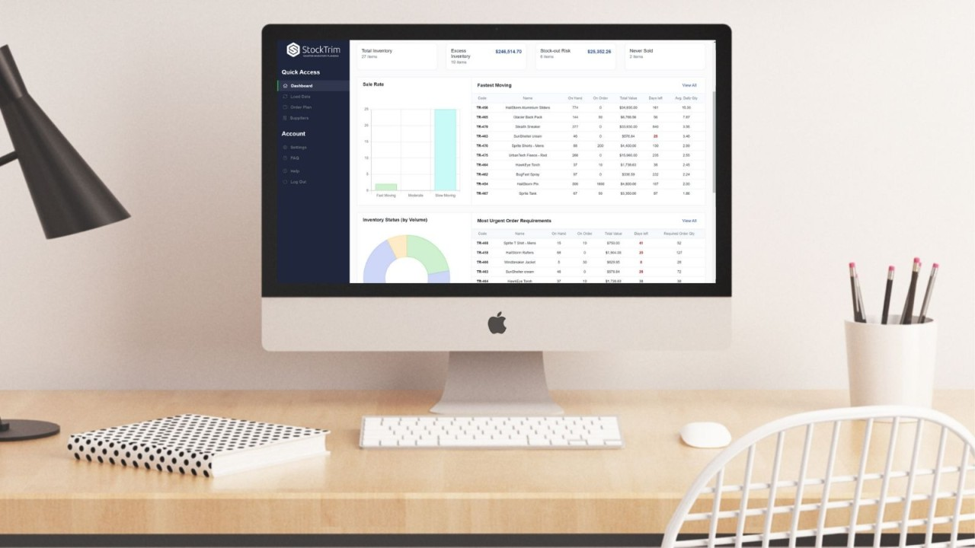
How does StockTrim work?
StockTrim connects to your data source (whether that's an IMS, or a CSV export) and begins analysing your sales patterns. Its machine-learning algorithm identifies the best forecasting model for each individual SKU.
Instead of a one-size-fits-all formula, a model is selected per product based on its demand behaviour.
From there, it calculates:
• Recommended order quantities at the SKU level
• Dynamic reorder points that adjust as lead times change
• Safety stock buffers based on demand variability
• Suggested purchase orders, ready to review and send
New SKUs can be forecasted without any sales history
Most forecasting tools require sales history before they can generate a forecast. However, with a new product launch, there is no data to draw from.
StockTrim approaches this differently. By benchmarking a new SKU against similar products already in your catalogue (matching on category, price point, sales velocity, or other attributes), it generates a demand estimate. For businesses that regularly introduce new lines, this is a material capability.
Multi-location planning
If your stock sits across multiple warehouses, 3PLs, or geographic markets, StockTrim plans at the location level. You can see where stock is holding, where it's running low, and where transfers might make more sense than a new order — all from a single view.
Automated purchase orders
Once StockTrim has generated its recommendations, your team simply reviews and approves the POs.
The time saving across StockTrim's user base averages 75% in purchasing admin. For a team spending two days a week on purchasing, that's roughly 1.5 days back.
Read more: How does StockTrim's demand forecasting work?
Inventory Planning Solutions Compared: StockTrim vs Spreadsheets vs IMS vs Enterprise ERP
Here's a practical look at how common approaches stack up for SMBs that need both inventory visibility and forecasting:
|
Feature |
StockTrim |
Spreadsheets |
Basic IMS only |
Enterprise ERP |
|
Demand forecasting |
✅ AI-driven |
⚠️ Manual |
❌ None |
⚠️ Add-on cost |
|
New SKU forecasting |
✅ Yes — no history needed |
❌ Not possible |
❌ Not possible |
⚠️ Limited |
|
Automated POs |
✅ One-click |
❌ Manual |
⚠️ Basic |
✅ Yes |
|
Multi-location support |
✅ Yes |
❌ Complex |
✅ Yes |
✅ Yes |
|
Lead time automation |
✅ Dynamic |
❌ Manual |
⚠️ Static |
✅ Yes |
|
SMB-friendly pricing |
✅ From $49/mo |
✅ Free |
✅ Low cost |
❌ High cost |
|
Multi-level bill of materials (BOM) |
✅ Yes |
❌ Complex |
⚠️ Basic |
⚠️ Limited |
|
Time to value |
✅ Days |
⚠️ Weeks to build |
✅ Fast |
❌ Months |
• Spreadsheets are effective for businesses with small catalogues and stable demand.
• Pure IMS platforms are essential for stock tracking but offer little predictive capability.
• Enterprise ERPs provide full functionality but at a cost and implementation timeline that rules them out for most SMBs.
StockTrim is built to fill the gap - adding AI-driven forecasting on top of your existing stack, without replacing it.
Who is StockTrim built for?
StockTrim is particularly well-suited to:
• Manufacturers managing components and finished goods across multiple BOMs
• Wholesalers and distributors handling large SKU counts with variable lead times
• E-commerce operators on Shopify who need forward-looking stock planning
• Businesses already on an IMS who want to add a forecasting layer
• Operations teams spending more than a few hours a week building purchase orders manually
It is less suited to businesses with very small catalogues (under 20 SKUs) where manual planning remains practical, or businesses in early-stage growth that haven't yet accumulated enough transactional data.
Getting started
StockTrim is cloud-based and requires no on-premises installation. The starting subscription is $49 per month - structured to scale with your business, with no hidden fees.
Most businesses connect their data sources and begin generating forecasts within a few days.

Frequently asked questions
What is the difference between inventory management and inventory forecasting?
Inventory management deals with what you have — tracking, storing, and moving stock. Inventory forecasting deals with what you should have — predicting future demand to optimise order quantities and timing.
Do I need separate software for inventory management and forecasting?
Some dedicated IMS have built-in forecasting abilities. However, they only work for users within the ecosystem. StockTrim is system agnostic, it integrates with any system natively, with zero data migration needed. Most users get onboarded in under 30 minutes.
Can StockTrim forecast demand for new products with no sales history?
Yes. StockTrim can forecast new SKUs by benchmarking against similar products in your catalogue - a key differentiator from most tools that require historical sales data before generating any forecast.
How much can businesses save with an inventory forecasting software like StockTrim?
StockTrim users save an average of 40% in working capital by reducing overstock and stockouts, alongside a 75% reduction in purchasing admin time. You can calculate your potential ROI with our free calculator: https://www.stocktrim.com/calculate-your-roi